
Tempe Truck Accident Lawyer
Tempe, AZ Truck Accident Lawyer
If a delivery box truck clipped your vehicle at an intersection along Rural Road, a tractor-trailer rear-ended you merging onto US-60, or a flatbed drifted into your lane on I-10 through Tempe, you are likely facing injuries a passenger car was never built to absorb. Medical bills often arrive faster than your body heals, and the motor carrier’s claims representative often calls within a day or two, angling for a recorded statement that will later be used to minimize your claim.
We have represented injured Arizonans for more than three decades at Yearin Law Office. Don Yearin, a lifelong Arizona resident admitted to practice in 1991, has handled serious commercial vehicle cases against national carriers, their insurers, and self-insured fleet operators. Our Tempe, AZ truck accident law practice represents only injured victims and grieving families. We never work for trucking companies or insurance carriers. Reach out for a free consultation before the adjuster takes control of the narrative.
Why Choose Yearin Law Office for Truck Accident Cases in Tempe, AZ?
Truck accident claims involve regulatory layers and defense tactics that ordinary auto claims do not. Carriers often retain in-house investigators and specialized defense counsel. Evidence rotates through retention cycles that quietly overwrite the data you need.
Over 30 Years of Arizona Trial Experience
Our founding attorney, Don Yearin, was born and raised in Arizona. He earned a B.S. in Real Estate and Business from Arizona State University in 1986 and a Juris Doctor from the University of Arizona College of Law in 1990. He has been admitted to both the State Bar of Arizona and the U.S. District Court for the District of Arizona since 1991. Commercial vehicle cases often require a lawyer willing to try cases to verdict.
Meaningful Results in Commercial Vehicle Cases
Truck crashes tend to produce catastrophic injuries that demand a lifetime of medical care, and verdicts and settlements should match that reality. Our firm has secured millions of dollars for Arizona clients in cases against commercial carriers, their insurers, and manufacturers of defective truck components. The National Trial Lawyers has included Don Yearin on its Top 100 Civil Plaintiff Attorneys list, and he holds the AV Preeminent Rating from Martindale-Hubbell, along with additional career recognitions earned over three decades of practice. Our personal injury lawyer in Tempe, AZ handles all types of truck crash claims.
Federal Regulatory Knowledge Applied to Every Case
Interstate trucking companies must comply with rules issued by the Federal Motor Carrier Safety Administration (FMCSA). Those rules cover driver hours of service, pre-employment screening, drug and alcohol testing, vehicle maintenance, and cargo securement. Violations matter in court. A driver who exceeded the 11-hour daily limit operated illegally, and that violation can support a jury finding of negligence. We know how to subpoena electronic logging device outputs, dashcam footage, trip inspection reports, and driver qualification files before the carrier’s 30-day retention cycle wipes the record.
Representation of Injured Victims Only
We represent injured people and bereaved families. We do not represent trucking carriers, fleet operators, or insurance companies. That limit is intentional. Don Yearin is a longtime member of the Arizona Trial Lawyers Association, the Maricopa County Bar Association, the Scottsdale Bar Association, and the Arizona-Mexico Commission.
⭐⭐⭐⭐⭐
“I was referred to Don Yearin by an acquaintance who had a friend that had retained him and was quite pleased. Don handled all aspects of my case with professionalism and easy demeanor. It was such a relief after having one, not so enjoyable , conversation with the company’s insurance representative. Don was pleasant and patient while sometimes have to over explain the legalities and financial processes to me for my understanding. I wouldn’t hesitate to use him again, should the need arise. Highly recommend him!”
Karen Floch
Read more reviews on our Google Business Profile.
Types of Truck Accident Cases We Handle in Tempe
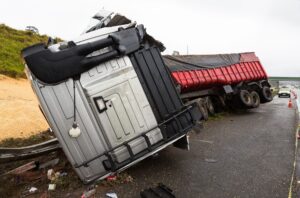 The mechanics of a commercial vehicle crash shape every piece of the claim that follows. We have handled the common and uncommon categories of truck crashes in and around Tempe. The categories below appear most often in our practice.
- Rear-end truck collisions. Stopping distance is the underlying issue. A loaded truck needs far more distance to stop than a passenger car, and fatigue, tailgating, or brake failure convert that gap into impact.
- Jackknife crashes. A trailer that swings out of line with the tractor blocks lanes and pulls other vehicles into the wreck. Weather, speed, and braking issues frequently appear in the root cause analysis.
- Underride accidents. When a smaller vehicle slides beneath the back or side of a trailer, the result is frequently fatal. Missing or damaged underride guards become pivotal evidence.
- Head-on truck collisions. Rare but almost always catastrophic. Fatigue, prescription medication, or a driver crossing the centerline on a two-lane road explain most of them.
- Rollover truck crashes. Tankers and top-heavy loads roll on sharp curves and freeway ramps. Driver training, loading practices, and speed all come under scrutiny.
- Wide-turn and blind-spot crashes. A truck making a right turn can sweep across adjacent lanes. Vehicles sitting in the “no-zone” around a commercial truck are often struck during lane changes.
- Cargo spill and shifted load accidents. Federal cargo securement rules exist for a reason. A load that shifts or falls onto the roadway implicates the loader, the shipper, and sometimes the carrier.
- Tire blowout and equipment failure crashes. Pre-trip inspections and maintenance records frequently tell the story. A truck driven with a known defect creates liability that extends beyond the driver alone.
- Wrongful death. When a commercial vehicle crash takes a life, surviving family members may pursue damages under Arizona’s wrongful death statute.
- DUI truck driver crashes. Commercial drivers are held to a 0.04 BAC threshold, half the limit for ordinary motorists. Post-crash drug and alcohol testing is mandatory under federal rules.
Arizona Legal Requirements for Truck Accidents
Several Arizona statutes and federal regulations shape every commercial vehicle claim we file. Understanding how they apply to your case matters.
Statute of limitations. A.R.S. § 12-542 sets a two-year deadline for most personal injury lawsuits in Arizona, measured from the date of the crash. Wrongful death actions follow the same two-year window, measured from the date of death. Claims against public entities are subject to shorter notice deadlines under a separate provision. Missing a deadline can extinguish an otherwise strong claim. Certain tolling rules may apply for minors or incapacitated plaintiffs, and we evaluate those issues at intake.
Pure comparative fault. Arizona applies a pure comparative negligence standard under A.R.S. § 12-2505. A plaintiff who is partially at fault for the crash still recovers, with the recovery reduced by that percentage. On a $400,000 claim where a jury finds the injured driver 25 percent responsible, the award is $300,000. Insurance defense teams work hard to shift fault to injured drivers, which is one of the reasons Arizona’s fault laws matter in every case.
Federal motor carrier rules. Interstate carriers and their drivers must follow the regulations published by the FMCSA. The regulations cover hours of service, medical certification, drug and alcohol testing, vehicle maintenance, and cargo securement. A violation can support a finding of negligence per se under Arizona law.
State motor carrier oversight. Arizona DOT administers commercial driver licensing and enforces state motor carrier rules. Commercial drivers face stricter BAC limits, medical certification standards, and disqualification rules than ordinary motorists.
What Damages Are Recoverable in Tempe Truck Accident Cases?
Commercial truck crashes result in injuries with long-term effects. Arizona law permits a plaintiff to recover economic losses, non-economic losses, and, in certain cases, punitive damages.
Economic damages. These are the measurable financial losses tied to the crash. Past medical bills. Future medical care, including surgery, rehabilitation, pain management, and home-based care. Lost income during recovery. Diminished earning capacity for those who cannot return to their prior profession. Property damage. Out-of-pocket expenses for mileage, assistive devices, and home modifications. A victim with a traumatic brain injury or severe orthopedic injury often needs a formal life care plan prepared by a credentialed specialist to project long-term costs accurately. A large truck crash routinely produces damages in this category well above what a standard auto claim would show.
Non-economic damages. These compensate for the human cost that receipts do not record. Pain and suffering. Emotional distress. Scarring and disfigurement. Loss of enjoyment of life. Loss of consortium for a spouse. For catastrophic cases such as spinal cord injury or a severe concussion, non-economic awards often exceed the economic number at trial. Claimants should also be cautious about accepting a first settlement offer from a carrier, as non-economic damages are nearly always understated in early communications.
Punitive damages. Arizona permits punitive damages against defendants whose conduct reflects an evil mind or conscious disregard for the safety of others. Courts in trucking cases have approved punitive awards for impaired driving, falsified logbooks to hide hours-of-service breaches, hiring drivers with known disqualifying records, and systemic failure to maintain equipment. Not every case qualifies, but when the facts warrant it, punitive damages are appropriate.
Wrongful death damages. When a truck crash causes a death, surviving spouses, children, and parents may seek damages for loss of companionship, loss of financial support, funeral and burial costs, and the pre-death pain and suffering of the decedent.
What Steps Should I Take After a Truck Accident?
The decisions made during the first week after a commercial vehicle crash shape the case. The ten steps below cover the priorities in order.
- Call 911 immediately. A crash involving a commercial truck generally requires an on-scene investigation by police or the Department of Public Safety.
- Accept paramedic transport. Even if you think you are fine, go to the hospital if paramedics recommend it. Brain bleeds, internal injuries, and spinal damage often develop symptoms hours later.
- Photograph everything. Capture both vehicles from every angle, the debris field, road conditions, skid marks, traffic signals, and weather. Record trailer and tractor numbers, the USDOT number on the cab, and any visible carrier or shipper logos.
- Collect driver information. Write down the driver’s name, CDL number, employer, and insurance. The driver’s employer, the truck’s owner, and the shipper of the load are often three different entities.
- Identify witnesses. Get names and phone numbers of anyone who saw the crash. Independent witnesses are often decisive in contested liability disputes.
- Decline a recorded statement. The carrier’s adjuster will request one in the first week. You are not required to give one, and doing so almost never helps your claim.
- Preserve your vehicle. Do not authorize repair or disposal until the damage has been inspected by an accident reconstructionist. The vehicle itself is evidence.
- Attend every medical appointment. Gaps and missed appointments give insurers a reason to argue your injuries are minor. Follow through with treatment from start to finish.
- Track expenses and lost wages. Save medical bills, receipts, pharmacy records, mileage to appointments, and written documentation of missed work from your employer.
- Contact a truck accident attorney without delay. Carriers dispatch rapid response teams within hours. Electronic data, ELD logs, and dashcam footage can be overwritten in as little as 30 days if not preserved by a formal letter.
Truck Accident Statistics in Tempe
 Commercial trucks contribute to a disproportionate share of the most serious crashes on American roads. NHTSA data shows that large trucks are involved in a far greater percentage of fatal crashes than their share of registered vehicles would predict.
The Insurance Institute for Highway Safety reports that a fully loaded tractor-trailer can weigh 80,000 pounds or more, twenty to thirty times what an average passenger car weighs. When those vehicles collide, the kinetic energy is transferred almost entirely to the smaller vehicle and its occupants. Truck occupants rarely account for the fatalities.
The FMCSA crash statistics database tracks commercial motor vehicle crashes by state and by carrier. Arizona records thousands of commercial truck crashes each year, concentrated along I-10, I-17, I-40, US-60, and the Loop 101 and 202 systems that serve Tempe and the rest of Maricopa County.
The Arizona Department of Transportation’s crash data section publishes annual Arizona Crash Facts reports. Commercial trucks are disproportionately represented in fatal crashes on Maricopa County freeways, and urban interchanges produce higher crash rates than rural corridors.
Research published by NIOSH points to driver fatigue as one of the most commonly cited contributing factors in serious commercial vehicle crashes. Sleep apnea, hours-of-service violations, and scheduling pressure from shippers each play measurable roles. Victims of rear-end collisions with a semi-truck or other large commercial vehicle often struggle for years with symptoms that would be less severe in an ordinary auto crash.
Recovery from a commercial truck crash is rarely quick. Spinal cord injuries, multi-system trauma, amputations, and severe brain injuries require months or years of workup before the true cost of care can be projected. Adjusters who understand that timeline sometimes push for quick settlements to close the file before the full extent of harm is known.
Tempe Truck Accident Lawyer FAQs
What counts as a truck accident?
Our practice covers crashes involving commercial motor vehicles: tractor-trailers, 18-wheelers, dump trucks, delivery box trucks, tankers, flatbeds, car haulers, and other vehicles regulated under federal motor carrier rules.
How long do I have to file a claim?
Generally, two years from the date of the crash under A.R.S. § 12-542. Wrongful death claims carry the same two-year window from the date of death. Notice-of-claim deadlines against government entities are much shorter, sometimes as short as 180 days.
Who can be sued after a truck crash?
Liability often extends to several parties. The driver. The motor carrier. The tractor owner. The trailer owner. The shipper. The loading contractor. A maintenance provider. And manufacturers of defective components.
What if I was partially at fault?
Arizona follows pure comparative negligence. A plaintiff whose fault is less than, equal to, or greater than the defendant’s can still recover, with the award reduced by the plaintiff’s percentage of fault.
How much is my truck accident case worth?
The value of your claim depends on injury severity, past and projected medical care, lost earnings, permanent disability, liability strength, and available insurance coverage. No lawyer should quote a figure before reviewing the records in detail.
Will my case go to trial?
Most truck accident claims settle. The ones that do not settle usually go to trial because an insurer is unwilling to pay a reasonable amount. Our firm prepares every case for trial from the outset, which tends to improve settlement leverage.
What role do ELDs play in a truck accident case?
Electronic logging devices record driving time and vehicle motion. Since late 2017, most interstate commercial trucks have been required to use them. ELD records often settle contested questions about driver hours and pre-crash activity. Our approach to proving the case often begins with preserving this data.
What is “hours of service”?
Federal rules limit how many hours a commercial driver can spend on duty and behind the wheel in a day and a week. Violations of those limits frequently correlate with fatigue-related crashes.
What if the driver was using a phone?
Federal rules restrict the use of handheld phones by commercial drivers. Carrier phone records, fleet management system logs, and the driver’s own device data can confirm or contradict a phone-use theory.
What if the cargo caused the crash?
Federal cargo securement rules apply to interstate shipments. A shifted load, a falling piece of equipment, or an overweight trailer can extend liability to the shipper and loading company.
Can I sue the insurance company directly?
Arizona claims generally proceed against the at-fault parties rather than the insurer. A bad-faith claim against an insurer is a separate action that may arise if the insurer refuses to pay a covered claim in good faith. Knowing insurer tactics is part of understanding what to expect during negotiations.
What if my family member was killed?
A wrongful death action may be filed by the surviving spouse, children, parents, or personal representative of the estate. Damages include loss of companionship, loss of financial support, funeral expenses, and pre-death pain and suffering.
How much does it cost to hire a truck accident lawyer?
We work on contingency. You pay no attorney fee unless we recover for you. Consultations are free, and we advance case costs during litigation.
What evidence is most important?
ELD data, dashcam footage, driver qualification file, drug and alcohol test results, maintenance records, inspection reports, and the carrier’s internal post-crash investigation file. Preserving those records early is often the pivotal step.
How soon should I hire a lawyer?
As soon as practical. Carriers deploy rapid response teams within hours of a significant crash. The earlier we are retained, the more we can do to preserve evidence before retention cycles erase it.
Most Dangerous Locations for Truck Accidents in Tempe
 Commercial truck crashes in and around Tempe cluster on a handful of corridors. Awareness of these zones helps drivers plan routes and helps us build claims for those injured in them.
- Interstate 10 through Tempe. The Maricopa Freeway carries heavy commercial traffic through the city and past the Loop 202 and US-60 interchanges. Crashes in this stretch are frequent and often severe.
- US-60 (Superstition Freeway). Truck traffic moving between Mesa, Tempe, and Phoenix runs along US-60 around the clock. Morning and evening peak periods produce the worst truck-involved crashes.
- Loop 101 (Price Freeway). The Price segment of the Loop 101 borders Tempe on the east and serves as a major commercial corridor between the East Valley and the Loop 202.
- Loop 202 (Red Mountain Freeway). The Red Mountain stretch along the north edge of Tempe sees heavy truck activity, particularly near the Rio Salado interchange and the connections to SR 143.
- Broadway Road. East-west commercial traffic on Broadway Road produces a notable share of urban truck-involved collisions.
- Apache Boulevard. Apache serves both commuter traffic and commercial delivery routes near Arizona State University and Mill Avenue.
- Rural Road. The Rural Road corridor sees steady commercial delivery traffic supporting retail, restaurant, and campus destinations.
- Priest Drive and McClintock Drive. Both corridors feed industrial and warehouse areas and contribute to truck-involved intersection crashes.
What Are Important Local Resources for Tempe Truck Accident Victims?
The following Tempe and Phoenix-area resources may help crash victims and families after a serious collision. Inclusion here is not an endorsement by our firm, and none of the organizations listed are affiliated with Yearin Law Office.
- Banner Desert Medical Center is a Level I trauma facility in neighboring Mesa, serving severe trauma cases across the East Valley.
- Chandler Regional Medical Center serves the greater East Valley with advanced trauma, neurology, and orthopedic services.
- The Tempe Police Department investigates crashes within city limits and issues traffic collision reports that claimants and insurers rely on.
- The Arizona Department of Public Safety investigates commercial vehicle crashes on interstate and state highways serving Tempe, including I-10, US-60, and the Loop 101 and Loop 202.
- The Arizona Department of Transportation oversees commercial vehicle licensing, motor carrier registration, and state crash data publications.
- The FMCSA SAFER system allows the public to look up motor carrier safety records, inspection history, and prior crashes by USDOT number.
- The Arizona Department of Insurance accepts complaints about insurance carriers handling claims in bad faith.
- The Arizona Attorney General’s consumer protection division handles complaints involving unfair and deceptive trade practices, which can arise in claims handling.
Contact Yearin Law Office
If you or someone you love has been hurt in a commercial truck crash, our attorneys are here to help.
Consultations are free, and there is no attorney fee unless we recover compensation for you. Contact us via our website or by phone to schedule a free case review with our Tempe truck accident lawyer. We respond promptly and will give you our honest view of your claim.